Share this post


.svg)
Offshore employee onboarding is the structured process of integrating a full-time remote hire located outside the US into your team's tools, workflows, culture, and performance expectations. Unlike domestic onboarding, it requires documented SOPs, intentional cultural integration, and clear communication protocols to replace the informal guidance employees would receive working on-site.
Quick Answer: Offshore employee onboarding works best when you treat it as a structured 90-day program, not a single-day orientation. The key difference from domestic onboarding is that everything informal, hallway conversations, shoulder-taps, passive cultural absorption, must be made explicit and documented. Get the logistics, legal agreements, and tools set up before day one, then run a structured 30-60-90 day plan with clear milestones.
Key Takeaways:
- Offshore onboarding fails most often due to missing SOPs, time zone miscommunication, and no formal performance checkpoints, not because the hire was a bad fit
- The Five C's framework (Compliance, Clarification, Culture, Connection, Check-Back) maps directly to the specific challenges of offshore hiring
- A 30-60-90 day onboarding plan with role-specific KPIs is the single most reliable way to compress ramp time for offshore SDRs, digital marketers, and creative hires
- Legal and payroll complexity across international borders is real, using an Employer of Record (EOR) model or a partner like Remote Growth Partners removes that burden entirely
- Candidates who complete paid real-work tests before you ever meet them start onboarding already proven, which cuts ramp time significantly
Most US business owners treat offshore onboarding like they'd treat any new hire: send a welcome email, share the Slack link, and figure out the rest as they go. That works passably in a shared office. It doesn't work across time zones and countries.
The differences are structural, not cosmetic. When you hire domestically, a new employee absorbs enormous amounts of context without even realizing it, they overhear conversations, pick up on team norms, grab coffee with a colleague who explains how things actually work. None of that happens with an offshore hire. Every piece of context that would normally transfer through proximity has to be deliberately documented and communicated.
There's also the compliance dimension. Hiring someone in the Philippines, Colombia, or South Africa involves different labor laws, tax structures, and contract requirements than hiring in your home state. Get that wrong and you're exposed to legal and financial risk that takes real effort to unwind.
The good news: when offshore onboarding is done right, it's repeatable and scalable. A US business owner who builds a solid offshore onboarding process for their first offshore sales rep can replicate it across every subsequent hire. The upfront investment pays back many times over.
Blame usually lands on the candidate. "They weren't the right fit." "Communication was a problem." "They just didn't get it."
But when you look at what actually happened in those first 90 days, the pattern is consistent: the employer didn't have a structured process, and the offshore hire was left to piece together their role from scattered instructions and delayed responses. The hire didn't fail. The onboarding failed.
Without a structured onboarding process, offshore employees spend their first weeks doing the equivalent of asking "what should I work on?" over and over, except they're doing it in Slack at 9am their time, which is 9pm yours. The response comes 12 hours later. Multiply that by every ambiguity in their role and you've burned three weeks on back-and-forth that a well-written SOP document would have solved in an afternoon.
Standard Operating Procedures (SOPs) aren't optional for offshore teams. They are the infrastructure. A good SOP for a sales role, for example, should cover: the outreach sequence step by step, which CRM fields to fill and when, how to handle objections by type, and what "done" looks like for each deliverable. Vague guidance ("just follow up with leads") is friction in disguise.
Time zone misalignment doesn't just mean delayed responses. It creates a specific problem: the offshore employee makes a decision, acts on it, and by the time you see it, the work is already done the wrong way. Correcting it costs double the time.
The fix is asynchronous communication discipline. Set up daily or end-of-shift Loom videos or written updates so you see progress without needing live calls for every check-in. Use tools like Slack with clear channel structures so questions have a home and answers are searchable. Overlap hours, even one to two hours a day where you're both online, should be protected and used for decisions, not status updates.
This one gets ignored most often. Cultural integration isn't about team-building exercises. It's about helping your offshore hire understand how your company communicates, what "good work" looks like internally, how much autonomy they're expected to use, and what the norms are around pushing back on instructions.
A hire from the Philippines, for instance, may default to agreement in conversation even when they have a real concern, because directness can feel disrespectful in their professional culture. That's not a character flaw, it's a cultural default. If you don't proactively create space for candid feedback (through structured check-ins, anonymous pulse surveys, or explicit invitations to flag problems), you won't hear about issues until they've already compounded.
Everything that can be done before your hire's first day should be done before their first day. That means:
Pre-boarding is where most businesses drop the ball. When an offshore hire logs in on day one to find no email account set up and no instructions waiting for them, you've already lost a week of momentum and sent a clear signal that this wasn't fully thought through.
Day one is about two things: making the person feel like they joined a real team, and getting them fully operational in your systems. Walk them through each tool personally, don't just send a list of logins. A 60-minute orientation call covering Slack, your project management tool (Asana, ClickUp, or similar), and your CRM goes a long way.
Introduce them to any team members they'll work with regularly. Even a 10-minute "meet the team" Zoom call signals belonging in a way that an email introduction never does.
By end of week one, your hire should be able to answer three questions without asking you: What am I responsible for? What does success look like in 30 days? How and when should I communicate with you?
This is also the week to walk through your SOPs in detail, not just send the documents. Run a short Zoom session where you narrate through the most important process documents and invite questions. Record it. Add the recording to your internal wiki so it's permanently available.
Establish explicit communication norms: which channel for which type of message, expected response times, and when async is fine versus when a call is needed.
By week two, your hire should be doing real work, not just training. This is where the rubber meets the road, and also where feedback needs to become a regular habit rather than an occasional correction.
Schedule a 30-day check-in call with a structured agenda: what's working, what's unclear, what needs adjustment. Review their output against the KPIs you set during week one. If something's off, course-correct here, not at the 90-day review.
The 30-60 day window is also when you calibrate communication rhythms. Some hires need more check-ins; others are fully autonomous by day 30. Match your cadence to the individual and the role.
The 90-day review is a formal milestone, not a casual chat. Come prepared with data: output volume, KPI attainment, quality of work, communication reliability. Share the data with the hire, not just your impressions of it.
This is also when retention becomes a real conversation. Offshore employees who feel seen, measured fairly, and given a path forward stay. Those who feel like they're producing into a void eventually disengage. Use the 90-day mark to discuss what the next quarter looks like, what growth is available to them, and what ongoing development support you'll provide.
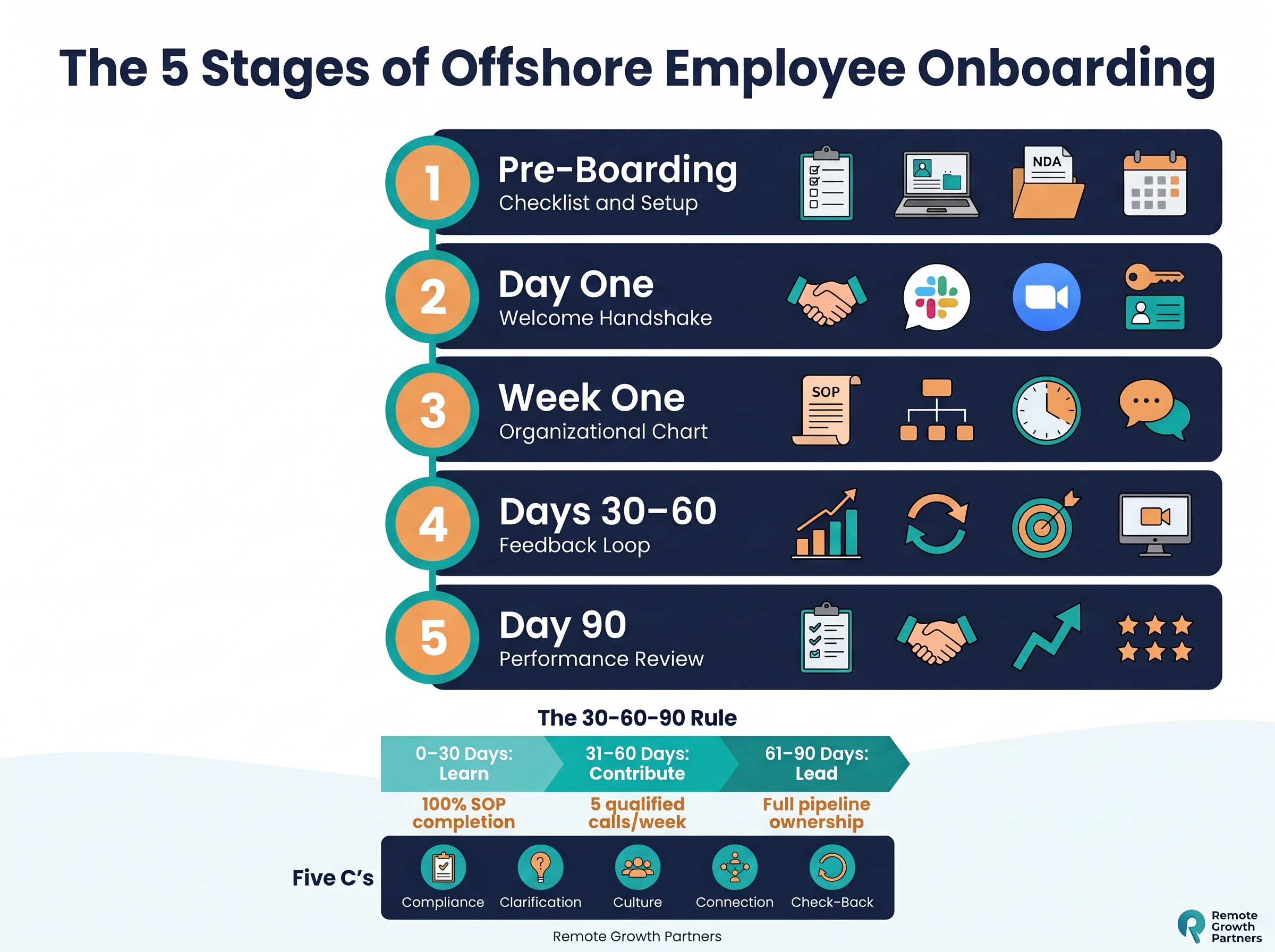
The 30-60-90 onboarding rule is a structured milestone framework that divides the first three months of employment into three focused phases: learning, contributing, and leading (or fully owning) their role. For offshore employees specifically, each phase has distinct goals.
| Phase | Focus | Key Milestones |
|---|---|---|
| Days 1–30 | Learn | Complete tool setup, understand SOPs, shadow processes, ask questions |
| Days 31–60 | Contribute | Execute real work with oversight, meet initial KPIs, flag blockers fast |
| Days 61–90 | Own | Operate independently, hit role KPIs, contribute to process improvements |
Note from practice: The biggest mistake in the 30-60-90 model is making day 30 a "still learning" checkpoint when the hire is capable of contributing earlier. Capable offshore hires, especially those who completed real-work tests during the hiring process, are often ready to produce meaningful output by week two. Don't artificially slow them down.
If milestones aren't being met, the 60-day check is where you course-correct without drama. Missing a 90-day mark without intervention typically means the first 60 days lacked enough structure to catch the drift early.
Failing to sort out tool access before day one is like handing someone a job description with no desk and no computer. Here's the full checklist:
This section is where most business owners either get overwhelmed or make expensive mistakes. International hiring isn't inherently complicated, but it requires the right structure from the start.
Every country where you hire has its own rules around working hours, leave entitlements, termination notice periods, and mandatory benefits. The Philippines, for example, requires 13th-month pay as a statutory benefit. Colombia has mandatory social security contributions. South Africa has specific BCEA protections around working hours.
You don't need to become an expert in each country's labor code, but you do need to ensure someone is. Check resources like the ILO's working conditions country profiles ↗ for baseline compliance requirements in each region you're hiring from.
| Model | Who Owns Legal Employment | Compliance Responsibility | Best For |
|---|---|---|---|
| Employer of Record (EOR) | Third-party EOR entity | EOR handles compliance | SMBs without local entities |
| Direct Employment | Your company | You (or local counsel) | Companies with established entities abroad |
| Staffing Partner (e.g., RGP) | Staffing partner | Partner handles payroll + compliance | Businesses wanting full-service support |
For most US-based SMBs hiring their first or second offshore employee, the EOR or staffing partner model is the practical choice. Setting up a local entity in the Philippines or Colombia to hire one person costs far more in time and legal fees than the savings justify.
Payroll administration for offshore employees involves currency conversion, local tax withholding, social contribution compliance, and payment timing requirements that vary by country. Getting this wrong creates liability and erodes trust with your hire when payments are delayed or incorrect.
Remote Growth Partners handles payroll administration entirely on behalf of clients, your offshore hire is on RGP's payroll, and you pay a simple monthly fee. No foreign bank accounts, no local tax filings, no compliance research required.
According to a 2024 Deloitte Global Payroll Survey ↗, 73% of companies managing multi-country payroll in-house report significant compliance errors in the first year. Using a dedicated payroll partner eliminates this risk category almost entirely.
The Five C's of employee onboarding, Compliance, Clarification, Culture, Connection, and Check-Back, are a well-established HR framework. Applied to offshore hiring, each takes on a sharper meaning:
Compliance: Not just signing forms. For offshore employees, this includes understanding country-specific legal requirements, data handling obligations, and IP ownership. Get these signed and acknowledged before day one.
Clarification: Job descriptions are starting points, not role manuals. Clarification means your hire knows exactly what they're accountable for, what tools they'll use, and what "excellent work" looks like in their specific role. This requires documented SOPs, not verbal explanation on a single Zoom call.
Culture: The hardest C to deliver remotely. Culture for offshore teams must be intentional. That means scheduled team calls, shared Slack channels where non-work conversation is normal, explicit feedback norms, and documented values that explain the "why" behind how your company operates. Culture doesn't travel through osmosis when there's an ocean between you.
Connection: Offshore employees who feel isolated from the team disengage faster. Connection requires deliberate effort: introduce them to collaborators, include them in team calls even when their role isn't central to the agenda, and acknowledge their contributions publicly.
Check-Back: Regular structured check-ins, not just when something goes wrong. A weekly or biweekly 1:1 with a clear agenda is the minimum. Use these to surface blockers early, before they become retention problems.
Vague expectations produce vague results. Every offshore hire should have specific, measurable KPIs established by the end of week one.
For offshore sales reps who are ready to produce from week one, standard metrics include:
For a deeper playbook on this, the 30-Day Offshore SDR Onboarding Playbook for U.S. Businesses covers the full ramp timeline specific to sales development roles.
Offshore digital marketers and SEO specialists should be measured on:
For offshore video editors and offshore graphic designers, output-based metrics work best:
The hardest part of offshore onboarding isn't the 90-day plan or the SOP documents. It's starting with the right person. Every other part of onboarding gets easier when your hire already understands the role, has demonstrated the skills, and has been matched specifically to your company's needs.
That's the core difference in how RGP operates versus a generic hiring platform.
Every RGP client gets a dedicated Account Manager who isn't just a contact person, they're an active part of the management relationship. The Account Manager knows your hire, knows your goals, and steps in when performance questions arise, communication gets difficult, or you need to adjust the scope of the role.
This means you don't have to become an offshore HR expert overnight. You have a partner who's already done this hundreds of times and knows where offshore team relationships typically break down. That ongoing support is what separates a well-functioning offshore hire from a frustrating one.
"Business owners who use a managed staffing model report spending significantly less time managing offshore team logistics, freeing them to focus on the work the hire is actually doing." — Society for Human Resource Management (SHRM) research on managed staffing outcomes ↗
RGP's four-stage vetting process reviews 1,000+ candidates per role before a single name is presented to the client. The final stage is a paid 3–5 hour real-work test, not a simulation, not a sample task, but an actual piece of the job. An SDR candidate might run a cold outreach sequence. A video editor delivers a finished cut of provided raw footage. A digital marketer audits a real website and writes a prioritized recommendation report.
By the time you meet your RGP candidate, you're looking at someone who has already proven they can do the work. That compresses ramp time dramatically because the 30-day "learning the basics" phase is largely done before the hire clock starts.
You can see how RGP vets offshore candidates before you ever meet them in full detail, and read what real clients say about working with RGP from businesses who've already gone through the process.
If you're also evaluating which country to source from, the guide on the best countries to hire offshore marketing talent in 2026 covers the trade-offs across talent quality, time zone alignment, and cost in detail.
Offshore employee onboarding is the structured process of integrating a full-time remote hire into your team's tools, workflows, culture, and performance expectations, and it differs fundamentally from domestic onboarding because informal context transfer must be replaced with documented SOPs and intentional communication. The most common failure modes in the first 90 days are lack of structured process, time zone-driven miscommunication, and cultural integration gaps, none of which are caused by the hire. A successful offshore onboarding program follows five sequential stages: pre-boarding logistics, day-one setup, week-one role clarity, a 30–60 day real-work feedback loop, and a formal 90-day performance review. Legal and payroll complexity across international borders is best managed through an Employer of Record model or a dedicated staffing partner that handles compliance on your behalf. Businesses that partner with Remote Growth Partners benefit from pre-vetted candidates who complete paid real-work tests before client introductions, significantly compressing the ramp time typical of offshore employee onboarding.
Offshore onboarding is the process of formally integrating a full-time employee based outside your home country into your company's systems, workflows, culture, and performance expectations. It differs from standard domestic onboarding because there is no physical office environment to provide informal context, everything must be explicitly documented and communicated, including SOPs, communication norms, and compliance agreements specific to the hire's country.
The 30-60-90 onboarding rule is a milestone-based framework that divides the first three months of a new hire's tenure into three phases: the first 30 days focus on learning (tools, processes, team norms), days 31–60 focus on contributing (executing real work under oversight), and days 61–90 focus on ownership (operating independently and hitting role-specific KPIs). For offshore employees, this framework is especially useful because it creates structured checkpoints that replace the organic progress-monitoring that would happen in a shared office.
The Five C's are Compliance, Clarification, Culture, Connection, and Check-Back. In an offshore context: Compliance covers legal documentation and country-specific labor requirements; Clarification means documented SOPs and explicit role expectations; Culture requires intentional integration efforts rather than passive osmosis; Connection involves deliberate relationship-building across the team; and Check-Back means regular structured 1:1s to surface blockers before they become retention problems.
The five stages are: (1) Pre-boarding, logistics, contracts, and system setup before day one; (2) Day one, orientation, tool access, and team introductions; (3) Week one, role clarity, SOP review, and communication norm-setting; (4) Days 30–60, real work, KPI tracking, and feedback loops; (5) Day 90, formal performance review and long-term retention planning. Each stage has different goals, and skipping early stages typically creates compounding problems in later ones.
For most US-based SMBs, the most practical approach is using an Employer of Record (EOR) or a dedicated staffing partner. These models keep your offshore hire legally employed through a local entity in their country, handle tax withholding and social contributions, and ensure you stay compliant with local labor law, without you needing to set up a foreign legal entity. Remote Growth Partners manages payroll and compliance entirely on behalf of clients across multiple countries, removing the legal and administrative burden from the business owner.
A structured offshore onboarding program runs 90 days from start to full productivity. However, candidates who have completed a real-work test during the hiring process, as all RGP candidates do, typically reach meaningful contribution by week two rather than week four or five. The 90-day framework is still valuable for establishing KPI baselines, refining communication rhythms, and building retention-focused habits, even when the hire ramps faster than expected.
Ready to build your offshore team without the guesswork? Browse all offshore roles RGP recruits for or get started with your first offshore hire today.
Recruiting, testing, and interviewing the most talented SDRs, designers, video editors, and marketers from overseas.