Share this post


.svg)
Sales outsourcing for healthtech is the practice of recruiting and managing dedicated offshore sales representatives, including SDRs, BDRs, and account executives, to build pipeline, generate leads, and drive customer acquisition for health technology companies, without the cost or complexity of full-time US-based hires. It gives growing healthtech companies a direct path to scalable revenue without the six-figure salary commitments that typically slow them down.
Key Takeaways:
- Sales outsourcing for healthtech lets companies place vetted offshore SDRs, BDRs, and AEs at a fraction of the cost of US-based reps, with as-needed scalability.
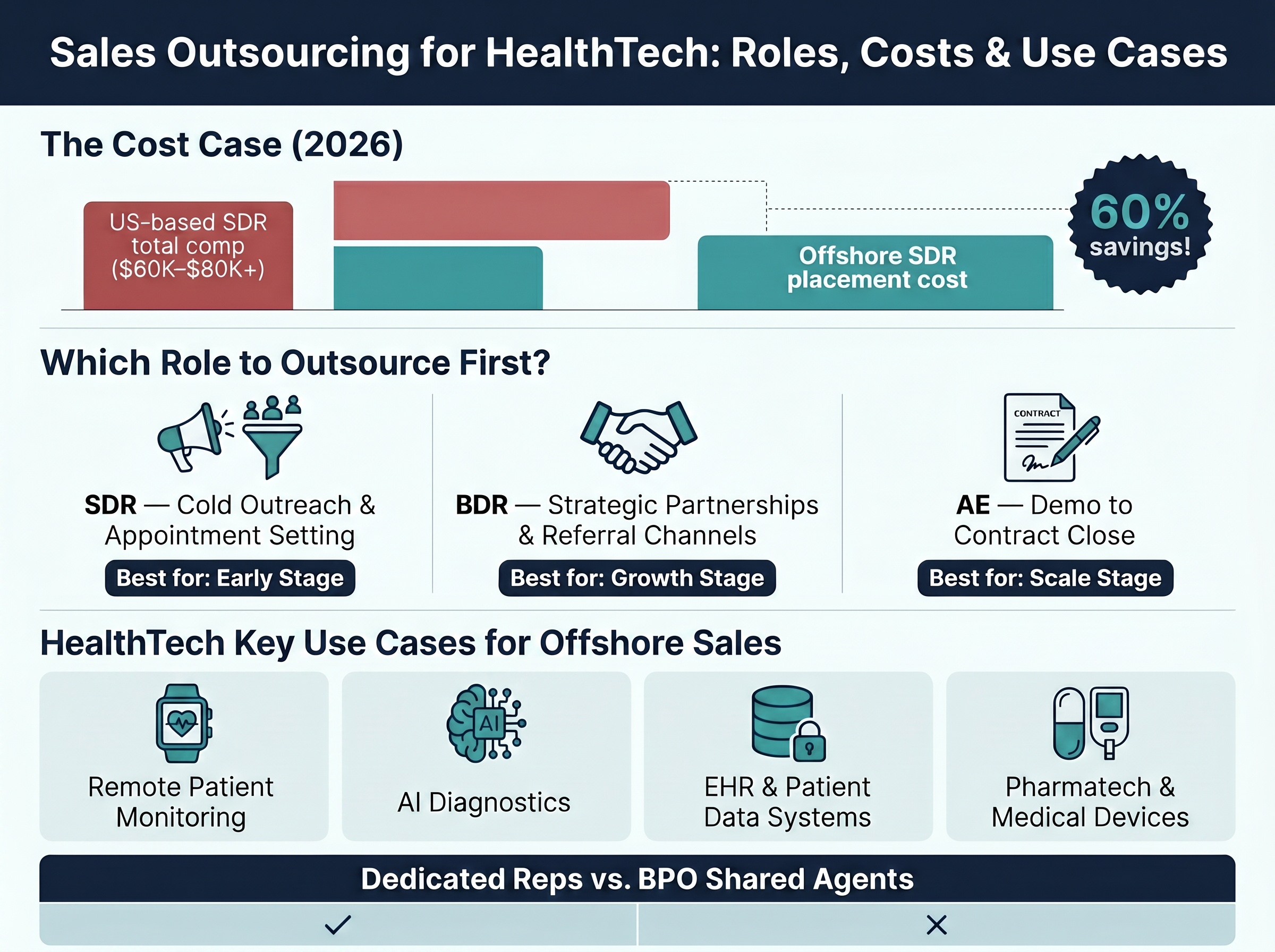
- As of 2026, a US-based SDR in healthcare typically costs $60K–$80K+ in total comp annually; an offshore equivalent can run $18K–$30K.
- Dedicated offshore reps (exclusive to one client) outperform shared BPO agents for healthtech because they learn your product, buyers, and compliance context deeply.
- HIPAA awareness is a real vetting criterion, even if offshore reps never touch PHI directly, they need to understand how to speak about data privacy in sales conversations.
- The best use of offshore sales outsourcing in healthtech: start with SDRs handling top-of-funnel outreach, prove the model, then layer in BDRs and AEs.
Quick Answer: Sales outsourcing for healthtech means hiring dedicated offshore sales reps, SDRs, BDRs, or AEs, to handle lead generation, pipeline development, and customer acquisition for health technology companies. It reduces the cost of building a sales team by 50–70% compared to US-based hiring, while giving companies access to reps who understand healthcare buyer psychology and can execute outbound strategies across EHR, remote patient monitoring, AI diagnostics, and other product categories.
Sales outsourcing for healthtech is the strategic decision to recruit, place, and manage external sales professionals, rather than building a full in-house team, to drive pipeline growth and customer acquisition. In practice, this means working with a staffing and management partner to hire offshore SDRs for cold outreach, BDRs for partnership development, or account executives to run full deal cycles.
The "outsourcing" part doesn't mean handing your sales process to a call center. Done right, it means a dedicated rep who works exclusively for your company, learns your product, and becomes part of your team, just not on a US payroll.
For healthtech companies specifically, sales outsourcing addresses a very real tension: healthcare is one of the most complex and compliance-sensitive markets to sell into, and the reps who know it well are expensive. Offshore sales outsourcing breaks that equation.
Selling into health systems, hospital networks, or clinical IT departments is not a 30-day sprint. Enterprise sales cycles in healthtech routinely run six to eighteen months, involve multiple stakeholders, clinical, IT, procurement, compliance, and require reps who can hold a relationship across a long decision window.
That complexity means you can't just hire a generalist and hope they figure it out. The learning curve alone can cost you a year.
As of 2026, the average total compensation for a US-based SDR with healthcare domain knowledge sits between $60,000 and $80,000 annually, and that's before benefits, taxes, tools, and management overhead. A mid-market AE with a healthcare book of business can command $120K–$160K OTE.
For a Series A or B healthtech startup, that's a significant bet on a single hire. If that rep misses quota or leaves in month seven, the damage is compounding: pipeline gaps, recruiting costs, ramp time for a replacement.
Healthcare sales requires more than cold-calling chops. Reps need to understand hospital procurement processes, how clinical decision-makers differ from IT buyers, why patient data protection matters in a sales conversation, and how to navigate security reviews that come standard in most enterprise healthcare evaluations.
That specific combination, sales skill plus healthcare context, is genuinely rare. It's why in-house sales team building in healthtech is so slow and expensive for most companies under 50 employees.
The math is direct. A US-based SDR at $70,000 total comp costs roughly $5,800/month before employer taxes and benefits, which typically add another 20–30%. An offshore SDR placed through a quality partner runs $18,000–$30,000 annually, a cost savings of 55–75%.
At a conservative 60% savings, a healthtech company replacing two US-based SDRs with offshore equivalents frees up roughly $84,000 per year, enough to fund a second sales tool stack, a fractional sales director, or two more offshore reps.
That's not just cost reduction. It's capital reallocation toward revenue growth.
One of the strongest arguments for outsourced sales in healthtech is speed. Testing a new vertical, say, moving from independent physician practices into hospital systems, normally requires a new hire, a ramp period, and a pipeline lag of three to six months before you know if the motion works.
With an offshore SDR placed quickly through a vetting-first partner, you can run a structured market entry experiment in 90 days at a fraction of that cost. If the vertical responds, you scale. If it doesn't, you adjust without a severance conversation.
This is where AI skills your SDR needs in 2026 come in. The best offshore SDRs in 2026 are running AI-assisted prospecting workflows using tools like Apollo, Outreach, and HubSpot, not just sending manual emails. That technical fluency, combined with proper healthcare sales training, creates a rep who can operate at a level most healthtech startups couldn't afford to build in-house.
According to research from McKinsey & Company ↗, digital transformation in healthcare is accelerating buyer adoption of new health technology, which means more prospects and more outreach opportunities, not fewer. Offshore SDRs who can execute at volume and speed are well-positioned to capture that demand.
Remote patient monitoring (RPM) sales typically targets physician groups, home health agencies, and integrated delivery networks. The sales motion involves reaching clinical directors and practice administrators with a mix of clinical outcomes data and reimbursement education. Offshore SDRs excel here at top-of-funnel outreach, identifying the right decision-makers, running multi-touch sequences, and booking discovery calls for a senior AE to run.
AI diagnostics tools often face a longer evaluation cycle because they sit inside clinical workflows. The buyer is usually a CMIO, a radiology department head, or an IT VP. Offshore SDRs for this category need to be comfortable with technical product positioning and credentialed-audience outreach. The goal isn't to close, it's to get the right stakeholders to a demo. That's a specialized but learnable skill set that offshore reps trained in healthcare sales can handle well.
EHR and patient data platform sales are among the most compliance-heavy in the sector. Buyers will ask about security certifications, data residency, and HIPAA compliance ↗ in the first conversation. Offshore reps supporting these sales cycles need thorough product briefings and a clear understanding of how to address data privacy questions, not because they're handling PHI, but because their prospects will test them on it.
Pharmatech and medical device sales often involve a mix of clinical and procurement stakeholders, sometimes with GPO or IDN contracting complexity layered in. Offshore SDRs in this space typically focus on outbound research, contact list building, and setting qualified introductory calls. BDRs can support strategic partnership development with group purchasing organizations or regional health systems. Both roles are well-suited for offshore delivery when the vetting process includes healthcare sales context.
| Role | Primary Focus | Best Use Case in HealthTech | Recommended to Outsource? |
|---|---|---|---|
| SDR (Sales Development Rep) | Cold outreach, lead qualification, appointment setting | Top-of-funnel prospecting into hospitals, clinics, or health systems | Yes, strong starting point |
| BDR (Business Development Rep) | Strategic partnerships, referral channels, alliance building | GPO relationships, health system partnerships, referral network development | Yes, especially for scale-ups |
| AE (Account Executive) | Full deal cycle: demo through contract close | Complex enterprise deals with multi-stakeholder buy-in | Yes, with proper onboarding and US-based sales leadership support |
The SDR role is the highest-ROI starting point for most healthtech companies exploring offshore sales. The job is clear and measurable: research accounts, run outbound sequences, qualify inbound leads, and book meetings. An offshore SDR in the Philippines, Latin America, or South Africa can execute this function at 30–40% of the cost of a US-based equivalent, with no reduction in output quality when properly vetted.
If you want to understand where offshore SDRs perform best geographically, this breakdown of the best countries to hire offshore SDRs is a useful reference point before you commit to a region.
BDRs in healthtech typically work on business development motions, not just cold outreach, but channel partnerships, referral relationships, and strategic alliance building. This is a more senior role and requires a rep with strong relationship instincts. Outsourcing a BDR makes most sense for healthtech companies that have proven their direct sales motion and are ready to build indirect channels without hiring a full-time Business Development Manager domestically.
AE outsourcing in healthtech is more nuanced. These reps handle everything from demo to contract, which means they need deep product knowledge, strong objection-handling skills, and the ability to manage complex multi-stakeholder deals. With the right onboarding structure, including a solid offshore SDR onboarding playbook as a foundation, offshore AEs can absolutely close healthcare deals. The key is pairing them with a Sales Director or VP of Sales on the US side who handles executive escalation and contract negotiation.
Generic screening isn't enough for healthtech sales. A quality partner should use multi-stage vetting that includes actual sales tasks: mock discovery calls with healthcare buyer personas, cold email sequence writing, objection response scenarios. This weeds out candidates who look good on paper but can't execute in a healthcare sales context.
Before you sign anything, review questions to ask sales outsourcing companies before signing, specifically around how they test for industry-specific sales skills, not just general communication ability.
Offshore sales reps for healthtech don't typically handle PHI directly. But they do get questions about it. A strong outsourcing partner ensures reps understand:
According to the U.S. Department of Health and Human Services ↗, HIPAA's Security Rule applies to the electronic protection of health information, and healthcare buyers evaluate vendors partly on whether their entire sales and support organization reflects that culture. That includes how your SDRs talk about data in outbound messages.
This is where the distinction between a quality outsourcing partner and a generic BPO matters most. Business process outsourcing (BPO) firms typically use shared, rotating agents who handle multiple clients simultaneously. They learn scripts, not products. They're measured on call volume, not pipeline quality.
A dedicated offshore model means one rep, one client, full time. That rep learns your ICP, your messaging, your CRM workflow, and your buyers' specific objections. Over six months, they become genuinely embedded in your sales process, not interchangeable with a rep handling a pharmatech client next door.
For healthtech specifically, where trust and product knowledge matter in every conversation, shared BPO resources are a poor fit. Dedicated offshore staffing is the right model.
Direct overseas hiring sounds appealing until you hit the realities: local labor law compliance, currency conversion, benefits administration, and the management overhead of working across time zones without a local HR structure. A full-service offshore staffing partner handles all of this, payroll, compliance, ongoing management support, so your Sales Director can focus on pipeline strategy instead of employment paperwork.
Remote Growth Partners recruits and manages dedicated offshore sales reps specifically built for healthtech sales environments. Every candidate goes through a 4-stage vetting process that includes paid real-work tests, not just interviews. That means by the time you meet a candidate, they've already demonstrated they can write a cold email to a clinical IT director, handle an objection about patient data security, and run a structured discovery call.
Every rep placed through Remote Growth Partners works exclusively for one client. No shared pools. No rotating agents. Your rep learns your product, your competitive positioning, and your target accounts, and stays there.
As of 2026, healthtech companies using Remote Growth Partners' offshore SDR model are reducing their cost-per-pipeline-meeting by an average of 60% compared to US-based SDR hiring, while maintaining meeting quality sufficient for senior AE handoffs.
The full scope of what's available, from SDRs to AEs to BDRs, is covered on the view all offshore roles we place page. If you're ready to talk specifics about your healthtech sales team, the best starting point is to hire offshore sales reps and see how our model maps to your current pipeline gaps.
Want to understand the full process before committing? How our vetting process works walks through each stage, including the real-work test criteria specific to sales roles.
Sales outsourcing for healthtech is a proven strategy for scaling pipeline without the overhead of full-time US-based sales hires, which typically cost $60,000–$80,000+ annually for SDR-level roles. Offshore sales reps, SDRs, BDRs, and AEs, can support the full range of healthtech product categories including remote patient monitoring, AI diagnostics, EHR systems, pharmatech, and medical devices. The critical differentiator in any healthtech sales outsourcing engagement is HIPAA awareness and dedicated rep structure: shared BPO models do not perform well in compliance-sensitive healthcare sales environments. Remote Growth Partners provides exclusively dedicated, multi-stage vetted offshore sales talent with full payroll and compliance management, making it a purpose-built solution for healthtech companies looking to build scalable sales teams in 2026 without proportional headcount costs.
Healthcare sales outsourcing means hiring a partner to recruit, place, and manage dedicated offshore sales reps, SDRs, BDRs, or AEs, who handle lead generation and pipeline development for health technology companies. The client company directs the sales strategy; the outsourcing partner handles recruiting, vetting, payroll, and day-to-day management of the offshore rep.
Yes. Offshore SDRs and BDRs regularly support outbound sales motions into hospitals, health systems, and clinical IT departments. They handle prospecting, multi-touch outreach, and appointment setting. The key is role-specific vetting: reps need to understand healthcare buyer psychology, procurement processes, and how to speak credibly about data privacy, even in early-stage conversations.
A BPO (business process outsourcing) model uses shared, rotating agents who work across multiple clients simultaneously. A dedicated offshore SDR is a full-time rep assigned exclusively to one company, who learns your product, ICP, and sales process over time. For healthtech, where buyer trust and product knowledge matter from the first outreach, dedicated reps outperform BPO agents significantly.
Offshore sales reps in healthtech rarely handle PHI directly, but they do need to understand HIPAA and be able to speak confidently about data security in sales conversations. A quality outsourcing partner ensures reps are trained on secure communication protocols, how to position data privacy to healthcare buyers, and what not to promise during outbound prospecting. According to the U.S. Department of Health and Human Services ↗, HIPAA compliance culture extends to all vendor-facing communications, which includes how your SDRs represent your product.
Start with SDRs. The SDR role, cold outreach, lead qualification, appointment setting, is clearly scoped, measurable, and doesn't require the same level of product mastery as AE or BDR work. Once your offshore SDR is producing a consistent flow of qualified meetings, you can layer in a BDR for partnership development or an offshore AE for full-cycle closing. Most healthtech companies see meaningful pipeline results from offshore SDRs within 60–90 days of onboarding.
As of 2026, offshore SDR placement through a quality partner typically runs $18,000–$30,000 annually in rep cost, plus a management and placement fee depending on the partner. Compare that to a US-based SDR at $60,000–$80,000 total comp, and the savings range from 55% to 75%. For a two-rep team, that's $60,000–$100,000 in annual savings that can be redirected toward sales tools, content, or additional headcount. To see current pricing and model options, get started with offshore sales outsourcing and request a cost comparison for your specific sales headcount needs.
Offshore SDRs allow healthtech companies to test new buyer segments, hospitals vs. independent clinics vs. insurance networks, for example, without committing to a full-time hire in each vertical. You can assign an offshore SDR to a 90-day outbound experiment in a new market, measure response rates and qualified pipeline generated, and make data-driven decisions about whether to invest further. This is a far lower-risk approach to market entry than a $75,000 annual hire whose performance you won't accurately assess until Q3.
Recruiting, testing, and interviewing the most talented SDRs, designers, video editors, and marketers from overseas.



.jpg)