Share this post


.svg)
Hiring a social media manager in the US costs real money. A mid-level hire in a major market runs $4,500 to $7,000 per month before you factor in benefits, payroll taxes, and the overhead of a full-time W-2 employee. For most small and mid-sized businesses, that's a tough number to justify for a role that, in many cases, can be performed just as well from Manila, Medellín, or Cape Town.
That's why more US marketing teams and agencies are choosing to hire offshore social media managers: full-time, dedicated professionals who handle everything from content scheduling and community engagement to LinkedIn outreach and performance reporting, at a fraction of the domestic cost.
This guide covers what the role actually involves, what 2026 salary data shows across key hiring regions, how to vet candidates without getting burned, and what to expect from the offshore staffing process if you're doing it for the first time.
Quick Answer: An offshore social media manager is a full-time, dedicated remote employee based in a lower cost-of-living country (typically the Philippines, Latin America, or South Africa) who manages your brand's social media presence, content scheduling, community engagement, and performance reporting at 50–70% below US hiring costs. Unlike a freelancer or general virtual assistant, a dedicated offshore social media employee works exclusively for your business and operates as a true extension of your team.
Key Takeaways:
- Offshore social media managers typically cost $800–$1,800/month depending on region, versus $4,500–$7,000/month for a US hire.
- The Philippines, Latin America, and South Africa are the three primary talent markets, each with distinct English proficiency profiles and time zone considerations.
- A dedicated offshore social media employee works full-time for one client only, they are not a shared VA or freelancer juggling multiple accounts.
- Vetting should include at minimum four stages: video screen, job preview test, deep interview, and a paid real work test.
- Offshore staffing agencies handle payroll, compliance, and HR infrastructure so you don't have to navigate overseas employment law on your own.
An offshore social media manager is a full-time remote employee based outside the US who is responsible for managing your brand's presence across social platforms. They handle content scheduling, community engagement, Instagram/TikTok/Facebook management, LinkedIn management, competitor research, influencer outreach, paid social coordination, and performance metrics tracking.
The key distinction: this is not a freelancer you hire project-by-project, and it's not a general virtual assistant who handles a mixed bag of admin tasks. A dedicated offshore social media manager is focused exclusively on social media, works full-time for your business only, and is embedded in your marketing workflow the same way a domestic hire would be. The "offshore" part simply means they're based in a country where skilled professionals earn significantly less than their US counterparts, which is where the cost savings come from.
Core responsibilities typically include:
The math is simple. US businesses are dealing with rising labor costs, competitive hiring markets, and growing pressure to demonstrate ROI on marketing spend. Social media management is a high-frequency, process-driven role, exactly the type of work that translates well to a remote, offshore model.
The stigma around offshore hiring has also faded considerably. Businesses that were cautious five years ago are now on their second or third offshore hire, and the talent quality in top markets like the Philippines has matured. You can find professionals with three to five years of hands-on experience in Hootsuite, Buffer, Sprout Social, Meta Business Suite, and LinkedIn Campaign Manager, the same tools a US-based hire would use.
2026 salary data shows that the all-in monthly cost for an offshore social media manager ranges from $800 to $1,800 depending on the region, compared to $4,500 to $7,000 for a comparable US-based hire. That's a cost saving of 65–70% on a per-head basis.
For a marketing agency running five client accounts that each need social media management, the arithmetic is significant. Replacing even two domestic social media hires with offshore equivalents can free up $60,000 to $120,000 annually, capital that can be redirected toward client acquisition, tooling, or expanding service offerings.
"The question isn't whether offshore social media talent can do the job, at this point, the evidence is clear that they can. The question is whether your hiring and vetting process is rigorous enough to find the right person."
Beyond salary, domestic hires come with substantial overhead: employer payroll taxes, health insurance, paid time off liability, equipment, and the administrative burden of HR compliance. Offshore staffing models eliminate most of this. When you work through an offshore staffing provider, the compliance, payroll, and HR infrastructure are handled on the provider's side. You pay a flat monthly rate and manage the work. That's the entire relationship.
A freelancer might charge $25–$50 per hour but is simultaneously managing five other clients. Their attention is split, their availability is unpredictable, and there's no real continuity. When you hire a dedicated offshore social media employee, you get someone who shows up for your business every working day, learns your brand voice, builds platform-specific knowledge over time, and functions as a real team member rather than a vendor.
This distinction matters for social media roles in particular. Brand voice consistency, community engagement quality, and campaign continuity all improve when one person owns the work full-time, rather than a freelancer squeezing your account in between other engagements.
This is where businesses sometimes underestimate the scope. A well-qualified offshore social media manager covers a wide range of deliverables. Here's a breakdown of the core task areas.
The most foundational part of the role. Your social media manager uses scheduling tools like Hootsuite, Buffer, Later, or Sprout Social to plan, queue, and publish content across all active platforms. They maintain a content calendar, coordinate with your design team (or handle basic design themselves using Canva), and ensure posting consistency even during busy periods or campaign launches.
This is often the most time-intensive daily task. Responding to comments, managing DMs, flagging escalations, and keeping the conversation active on your posts requires consistent attention. An offshore hire can own this entirely, freeing your in-house team from the day-to-day noise while maintaining a responsive brand presence.
Managing these three platforms well requires more than just posting content. It means understanding each platform's algorithm, optimizing post timing, using platform-native features (Reels, Stories, Carousels, Lives), and tracking engagement patterns. A qualified offshore social media manager will have hands-on experience with Meta Business Suite and understand the nuances of organic reach on each platform.
LinkedIn is a separate discipline. For B2B companies especially, LinkedIn management goes beyond posting, it includes connection outreach, content strategy for thought leadership, engagement on industry posts, and sometimes coordinating with a sales team on warm lead generation. This pairs naturally with an offshore paid ads manager if you're also running LinkedIn paid campaigns.
For consumer brands and ecommerce businesses, influencer outreach is a meaningful part of the social strategy. Your offshore hire can manage the entire coordination workflow: identifying relevant creators, sending outreach templates, tracking responses, managing gifting logistics, and reporting on partnership performance. This is process-heavy work that doesn't require a senior strategist to execute.
Regular competitor research and social listening gives your brand a continuous edge. An offshore social media manager can track competitor posting cadence, engagement rates, campaign themes, and audience sentiment across platforms, then summarize findings into actionable weekly or monthly reports. Tools like Sprout Social and native platform analytics make this structured and repeatable.
Every social media hire should be accountable to numbers. An offshore social media manager tracks reach, impressions, follower growth, engagement rate, click-through rate, and conversion metrics across platforms. They build reporting dashboards and deliver regular performance summaries so you always know what's working.
Beyond day-to-day management, a strong offshore hire can support or lead campaign execution: product launches, seasonal promotions, giveaways, and brand awareness pushes. This includes coordinating assets with a designer (if you also have an offshore graphic designer or offshore video editor on the team), writing copy, and tracking campaign-specific KPIs.
The Philippines remains the most popular offshore destination for English-language social media roles. English proficiency here is exceptionally strong, it's the language of instruction in schools, and the culture has deep American influences through decades of exposure to US media, entertainment, and business practices. You'll find social media managers who write fluent, natural-sounding American English without the stiff phrasing that sometimes comes from non-native speakers.
As of 2026, businesses hiring in the Philippines can expect to pay $800–$1,500 per month for a skilled social media manager with two to four years of experience. Senior candidates with platform certifications, paid social experience, or agency backgrounds run $1,400–$1,800/month. The time zone runs 12–13 hours ahead of Eastern time, which most businesses manage through a two to three hour overlap window in the early morning US time, combined with async workflows.
The Philippines is also a well-established offshore market, the talent pool is experienced with remote work culture, familiar with US business norms, and generally comfortable operating in Western-style team environments. For a deeper look at why this market is so dominant, see our guide on the best countries to hire offshore marketing talent in 2026.
LATAM has become a compelling alternative for US businesses that prioritize real-time collaboration. Countries like Colombia, Mexico, Argentina, and Brazil sit in time zones ranging from one to three hours behind Eastern time, which means you get a near-full-day overlap with your US team. No early morning Zoom calls required.
2026 salary data for LATAM social media managers shows a range of $1,000–$1,800/month. That's slightly higher than the Philippines but still 60–65% below a US hire. English proficiency varies more by country and education level, but top-tier candidates, typically those with university degrees or agency experience, communicate fluently.
LATAM is also the obvious choice for bilingual brands. If you serve Spanish-speaking markets or want to run parallel English/Spanish content strategies, a LATAM-based social media manager is a natural fit.
South Africa is often underestimated. English is one of the country's 11 official languages, and for business-educated professionals, it's a native-level British English, clean, formal, and highly readable. The talent pool is growing as remote work infrastructure has expanded post-pandemic.
As of 2026, South African social media managers cost approximately $900–$1,600/month. The time zone (SAST, UTC+2) creates a natural overlap with European business hours and a partial overlap with the US East Coast morning. For US businesses with European operations or a global audience, this time zone positioning is an asset.
| Region | Monthly Salary Range (2026) | English Proficiency | Time Zone Overlap (US ET) | Est. Annual Cost |
|---|---|---|---|---|
| Philippines | $800 – $1,500 | High (American-influenced) | 2–3 hrs (morning window) | $9,600 – $18,000 |
| Latin America | $1,000 – $1,800 | High (bilingual capability) | Near-full day | $12,000 – $21,600 |
| South Africa | $900 – $1,600 | Native-level (British English) | Partial AM overlap | $10,800 – $19,200 |
| US-Based Hire | $4,500 – $7,000 | Native | Full overlap | $54,000 – $84,000 |
Cost savings of 65–70% are achievable when replacing a US-based social media manager with a dedicated offshore hire in any of the three primary talent markets. At the midpoint of each range, a Philippines-based hire saves approximately $48,000 per year compared to a US equivalent.
This comparison comes up constantly, and it matters. A virtual assistant (VA) and a dedicated offshore social media employee are not the same thing, and conflating them leads to unrealistic expectations on both sides.
A general VA is typically a multi-skilled generalist who handles a range of administrative, coordination, and light operational tasks. They often work for multiple clients simultaneously, with hours distributed across accounts. Their social media involvement might be limited to scheduling posts from a content calendar someone else built, not strategy, not engagement management, not reporting.
A dedicated offshore social media employee, by contrast:
The difference in output quality is significant. True team continuity, where one person owns the accounts, knows the community, and has months of brand context, simply cannot be replicated by a shared VA rotating tasks between clients.
If you want to see the full scope of offshore roles available beyond social media, browse the offshore roles we place to understand what a full offshore marketing team looks like.
Most bad offshore hires happen because the vetting process was too thin. A single video call and a portfolio review is not enough. Here is a structured four-stage process that filters for communication quality, actual skills, strategic thinking, and real-world performance under your specific conditions.
The first video call is not an interview. It's a screen. You're assessing communication quality: clarity, fluency, confidence, responsiveness, and whether the candidate can hold a professional conversation in English under mild pressure. You're also looking at their setup (stable internet, professional background, functional audio/video) because that's a signal about how they'll show up on client calls or internal team standups.
Keep this call to 20–30 minutes. Ask one or two questions about their experience with specific platforms and tools. Listen for specificity. A candidate who says "I've managed Instagram accounts for e-commerce brands using Later and Sprout Social, focusing on Reels performance and story-link CTR" is more credible than someone who says "I'm very experienced with social media."
After the screen, send a short asynchronous job preview test. This is a set of 3–5 tasks that mirror the actual work: draft three caption options for a hypothetical product post, create a basic content calendar outline for a week, or pull engagement metrics from a provided screenshot and summarize the takeaways.
The goal here is to see how they think and execute before investing time in a full interview. Treat the output as a filter. If their captions are generic, their calendar is vague, or their metrics summary misses the point, you've learned something important before spending another hour of your time.
Candidates who pass the job preview test move to a full interview, 45 to 60 minutes. Now you go deeper. Ask about specific platform algorithm updates and how they adapted their strategy. Ask how they'd handle a negative comment thread during a PR crisis. Ask them to walk you through a campaign they managed from brief to reporting.
You're assessing strategic thinking, platform fluency, and whether they'd function well within your team's workflow and culture. This is also where you gauge reliability and communication style under sustained conversation.
This is the step most employers skip, and it's the most valuable one.
Give the finalist a real or realistic task tied to your actual business: build a one-week content calendar for one of your social platforms, write five captions with hashtag sets, or pull a competitor analysis using a specific format. Pay them for the time, typically two to four hours of work at a reasonable hourly rate. This matters both ethically and practically: candidates who are worth hiring will take a paid test seriously.
What you're evaluating: quality of output under real conditions, how they handle ambiguity in the brief, whether they ask clarifying questions, and whether the final deliverable looks like something you'd actually publish.
The paid real work test is the single best predictor of hire quality. Portfolios can be curated, interviews can be rehearsed, but a live task under time constraints shows you exactly what working with this person will look like on day one.
Knowing what to avoid is as important as knowing what to look for. Watch for these specific warning signs:
There are two primary ways to hire offshore. Understanding the difference helps you choose the right approach.
Independent recruitment means you source, screen, interview, hire, and manage the compliance and payroll relationship directly. You find the candidate through job boards like OnlineJobs.ph or LinkedIn, hire them as an independent contractor or set up an Employer of Record (EOR) arrangement, and manage the relationship entirely on your own. This gives you maximum control and can be cheaper in the short run, but it's time-intensive and puts the legal and compliance burden squarely on you. Contractor classification rules vary by country, and getting it wrong creates liability.
Offshore staffing agencies handle the entire pipeline: sourcing, vetting, payroll infrastructure, compliance, and ongoing HR support. You receive a shortlist of pre-vetted candidates, interview your top choice, and begin onboarding. The staffing provider remains the employer of record in the offshore country, handling local labor law compliance, statutory benefits, and payroll processing.
For most US businesses without a dedicated HR or legal team, the staffing model is significantly lower risk. The monthly fee is higher than paying a contractor directly, but it buys you peace of mind on compliance, eliminates the sourcing burden, and typically comes with an ongoing point of contact if issues arise.
If you're an offshore marketing team member short of a full team, a staffing agency can also help you scale incrementally, placing one role at a time as your needs grow.
The Bureau of Labor Statistics ↗ and Society for Human Resource Management ↗ both provide useful context on US compensation benchmarks and global HR practices for businesses evaluating the cost-comparison case for offshore hiring.
Remote Growth Partners specializes exclusively in offshore sales, marketing, and creative roles. This isn't a general VA staffing platform. Every placement is role-specific, and the vetting process is built around what each role actually demands, not a generic screening template applied across all job types.
Remote Growth Partners maintains active talent pipelines across all three primary hiring markets. Candidate sourcing is targeted: the team is looking for social media professionals with demonstrated platform experience, not generalists who list social media as one of fifteen skills. Sourcing draws from professional networks, referral pipelines, and vetted talent communities in each region, which means candidates are typically pre-filtered before they enter the formal vetting process.
The vetting process mirrors the four-stage model outlined above: initial video screen, a job preview test tailored to the specific role (not a generic skills quiz), a deep structured interview, and a paid real work test running three to five hours. For social media roles, the work test typically involves a live content calendar build, caption writing, and a basic analytics interpretation exercise.
To understand how Remote Growth Partners vets offshore talent in full detail, including what the paid work test looks like for different role types, the process is documented on their How It Works page.
Once a candidate is placed, Remote Growth Partners handles payroll processing, local compliance, statutory benefits (where applicable), and HR documentation. Clients don't need to establish foreign entities, navigate local labor law, or manage the administrative side of the employment relationship.
Each placed hire also comes with dedicated account management, a single point of contact who knows both the client's business and the offshore employee's working arrangement. This means issues get resolved quickly rather than disappearing into a support ticket queue.
For US businesses that want to expand beyond social media, Remote Growth Partners can place an offshore paid ads manager, offshore graphic designer, or offshore video editor using the same model. If you're ready to build a team, the 2026 offshore marketing talent growth plan is a useful starting framework.
Bottom Line: Hiring an offshore social media manager through Remote Growth Partners gives US businesses access to full-time, dedicated social media talent at 50–70% below US hiring costs, with role-specific vetting, payroll compliance, and account management handled end-to-end. The dedicated model, one employee, one client, creates genuine team continuity that freelancers and shared VAs simply can't match.
Businesses that hire an offshore social media manager can access full-time, skilled social media talent at $800–$1,800 per month, representing a 65–70% cost reduction compared to US-based hires in 2026. The Philippines, Latin America, and South Africa are the three primary offshore talent markets, each offering strong English proficiency profiles and experienced professionals familiar with tools like Hootsuite, Buffer, Sprout Social, Meta Business Suite, and LinkedIn Campaign Manager. A dedicated offshore social media employee differs fundamentally from a freelancer or virtual assistant: they work exclusively for one client, own the social media function end-to-end, and build brand-specific knowledge over time. Vetting should follow a four-stage process including a paid real work test to accurately predict real-world performance. Remote Growth Partners handles the full offshore hiring lifecycle, sourcing, vetting, payroll, and compliance, so US businesses can build offshore marketing teams without the legal and administrative burden of doing it independently.
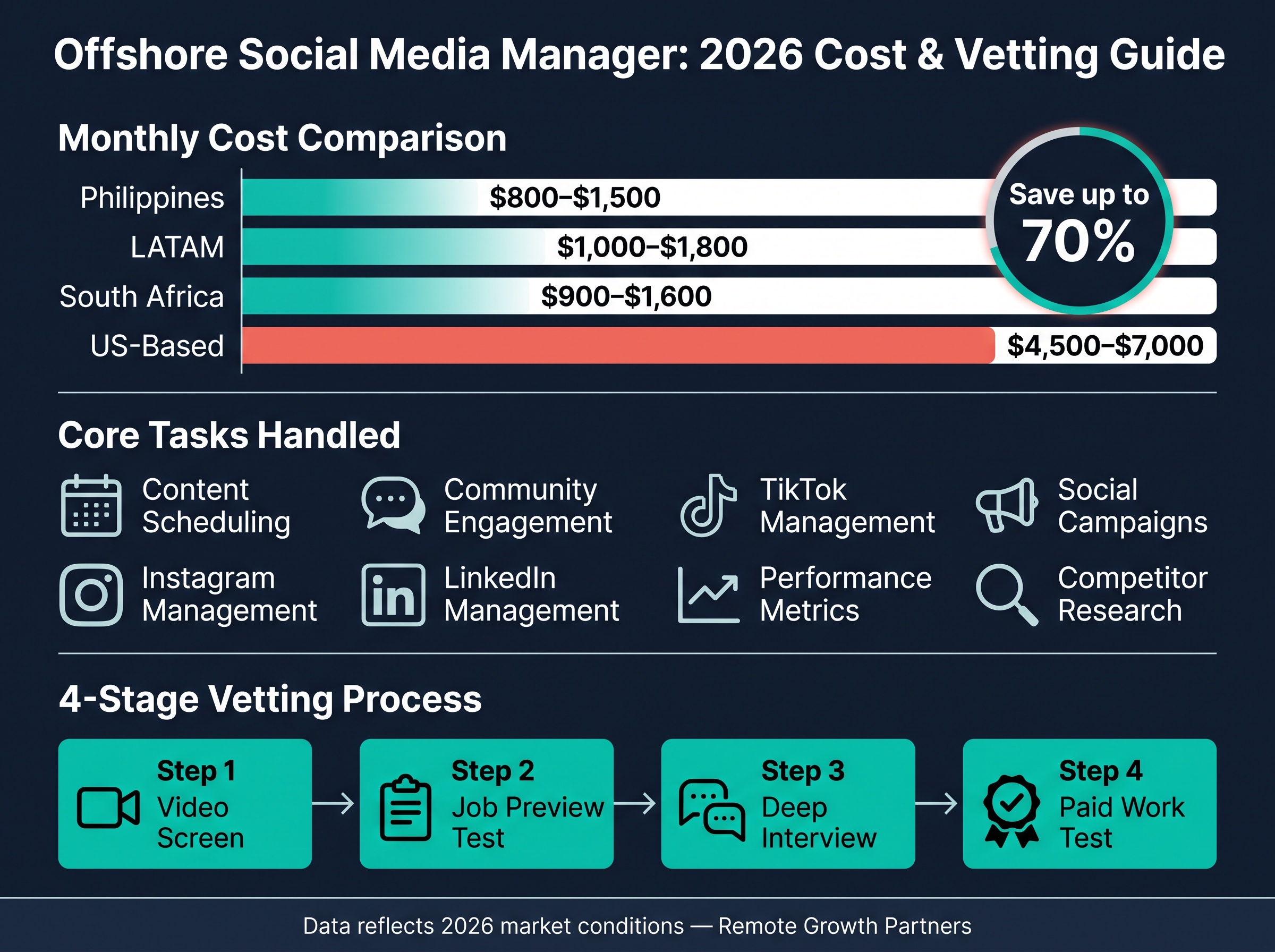
2026 salary data shows offshore social media managers cost $800–$1,500/month in the Philippines, $1,000–$1,800/month in Latin America, and $900–$1,600/month in South Africa. These figures represent the employee's salary. If you're hiring through an offshore staffing agency, there's typically a service or management fee on top of that. Even all-in, the total monthly cost remains 50–70% below the $4,500–$7,000 range for a US-based hire.
A virtual assistant is typically a generalist who handles administrative, coordination, and support tasks across multiple domains, and often works for multiple clients simultaneously. An offshore social media manager is a dedicated specialist who works full-time for one client, owns the entire social media function, and is accountable to platform-specific performance metrics. The depth of expertise, the exclusivity of the engagement, and the scope of responsibility are all significantly different.
It depends on your priorities. The Philippines offers the strongest combination of English proficiency, social media experience, and affordability, making it the most popular choice for US brands. Latin America is better for businesses that need real-time time zone overlap or bilingual (English/Spanish) content capability. South Africa suits businesses with European audiences or those who prefer British English writing style. All three markets have experienced, professional talent pools with demonstrated platform skills.
A qualified offshore social media manager can handle content scheduling and publishing, community engagement and comment management, Instagram/TikTok/Facebook management, LinkedIn management and outreach, influencer outreach and coordination, competitor research and social listening, performance metrics tracking and reporting, and social media campaign planning and execution. They work across tools including Hootsuite, Buffer, Later, Sprout Social, Meta Business Suite, and LinkedIn Campaign Manager.
The most reliable process involves four stages: a video screen to assess communication quality, a job preview test to evaluate baseline skills, a deep interview to assess strategic thinking and platform knowledge, and a paid real work test (three to five hours) that simulates real job conditions. The paid work test is the critical differentiator. Portfolios can be curated, interviews can be rehearsed, but a live task reveals actual output quality under real working conditions.
This depends entirely on the hiring model. With a dedicated offshore staffing model (like what Remote Growth Partners provides), the social media manager works exclusively for your business, full-time, just as a domestic hire would. In a shared VA or freelance model, the same person is splitting their time across multiple clients. For social media roles where brand voice consistency and community continuity matter, the dedicated model produces substantially better results.
As of 2026, social media managers in the Philippines with two to four years of professional experience earn approximately $800–$1,500 per month when working for US clients through an offshore arrangement. Senior-level candidates with paid social experience, platform certifications, or agency backgrounds command $1,400–$1,800/month. According to PayScale's global compensation data ↗, local Philippine market salaries are lower, but US-client offshore rates carry a premium that reflects the demand for English-language capability.
Yes, with the right candidate. LinkedIn management and outreach is a distinct skill set within social media, and experienced offshore managers who have worked with B2B clients will have hands-on familiarity with LinkedIn Campaign Manager, connection request workflows, and content strategy for thought leadership. Paid social ad management (Meta Ads, LinkedIn Ads) is a more specialized function, if your needs extend to campaign setup, audience targeting, and budget optimization, consider pairing your social media manager with a dedicated offshore paid ads manager.
When you hire through an offshore staffing agency, the agency typically serves as the employer of record in the offshore country. This means they handle local payroll processing, statutory deductions, mandatory benefits (where required by local law), and employment documentation. The client (you) pays a consolidated monthly fee that covers salary and the agency's management costs. This model eliminates the need to establish a foreign entity, hire a local HR team, or interpret country-specific labor law. The International Labour Organization ↗ provides useful context on global employment standards for businesses evaluating offshore hiring compliance.
Prioritize live account links over screenshots. Ask for specific platform handles or brand pages they've managed, so you can verify current engagement quality, posting consistency, and content style. Look for measurable outcomes: follower growth percentages, engagement rate trends, or campaign-specific results. Pay attention to platform variety, a candidate who has only managed one platform type is more limited than one with experience across Instagram, LinkedIn, and TikTok. Red flags include vague ownership claims, only showing results rather than the actual accounts, and an inability to explain the strategic reasoning behind content decisions.
Recruiting, testing, and interviewing the most talented SDRs, designers, video editors, and marketers from overseas.